


Everything is born in water and dies in it
[A journey through the 21st Century Amazon]
This piece was produced for Foundation Vist’s project “Amazonia Es Aqui” [The Amazon Is Here], for the exhibit “Amazonias, el Futuro Ancestral” [Amazonias, the Ancestral Future], at Centro de Cultura Contemporánea de Barcelona (CCCB), 2024.
This is not a river: it is a tree made of water.
Look at it from up high: the trunk is the Amazon
and its branches are hundreds of tributary rivers and thousands of streams
some so small they do not even have a name.
Scientists says it is the longest in the world
the most abundant in the world
the one with the most fresh water in the world
mightier than the Nile and the Ganges
than the Mississippi and all the rivers in China
than all the rivers of Europe
that river of rivers
that superlative river
which through its eight tributaries
crosses eight countries
and an overseas region
starting at an altitude of almost five thousand meters
in the Andes Mountains
as just a stream:
a trickle of water on the mountainside.
(Enter the current.
Descend with it.
It will be almost seven thousand kilometers.
More than the distance between New York and Paris
always travelling eastwards).
Now the river is three friends in a pickup truck
leaving behind the main square of Quito
with a driver named Darwin (without the Charles, of course)
and Maria Bethânia playing on the speakers
after seeing a golden plaque that reads:
“Babylon may well boast of its walls,
Nineveh of its greatness,
Athens of its letters,
Constantinople of its empire;
Quito conquers them
as the key to Christianity and as the conqueror
of the world, for to this city belongs
the discovery of the great Amazon River.”
The river is questioning the word “discovery”.
The river is questioning the word “conquest”.
It is wondering how much the Amazon has changed
with its more than forty million inhabitants
with its more than four hundred and twenty indigenous nations
how much your people, your science, your art, your politics have changed
over the course of these five centuries, how much (I wonder)
of all this is down to us.
So we arrive in Puyo
and the three companions
a Catalan (the curator)
a Colombian (the photographer)
a Peruvian (the chronicler)
spend one night under the sacred hut
of Yanda and Sani Montahuano
toasting tobacco leaves, sucking on ambil
drinking ayahuasca, the Rope of Death
in the jungle of the Sápara.
The river is seeing iridescent jaguars
fractal snakes
a sea of hands
voices calling you down
and down
to the bottom of an abyss of darkness
but you will always look for the light
and your companion will say he hasn’t seen a thing
and you will sleep in your hammock
and you will let yourself cry
and you will have a dream like
a very old memory
like the verses of a blind poet
that you now remember
you aren’t quite sure why:
“The world is a few vague
tepid observations.
The river is the original river.
The man, the first man.”
For most Amazonian cultures
the river is not a masculine being, but a feminine one.
Some call her Yacumama: Mother of Water.
“The river is a woman,” a Kichwa cacique will tell us
(because in the jungle everything is born in water and dies in it).
The river is not a torrent of liquid spilling into the Atlantic.
The river, this river, is above all a person.
Look, this is the Coca jungle.
Its name is also Francisco de Orellana
like that one-eyed captain, relative of Pizarro
who shipwrecked his brigantine, lost
along with two hundred soldiers
looking for The Land of Cinnamon.
Five centuries have passed since then.
There are commercial stores here now
and oil refineries spewing fire
and spills in Lago Agrio, a broken
pipeline in Petroecuador beside the highway
splashing the skin of the residents
the oranges and chickens of doña Elvia
who does not know whether to flee or stay
whether to stay or flee (where to?)
for fear of that viscous, prehistoric substance
that drives our machines
and fuels our cities.
The river is sailing in a boat
across the first frontier
passing Nuevo Rocafuerte
towards the military post of Cabo Pantoja
it is passing through a small dense cloud
and it is the rain suddenly surprising us
twelve minutes of thick fast drops
a gray sky, very gray
until you go back to the blue, to the ever green
to the sun on your face.
Then you will realize
(too) that in this jungle of water
borders are nothing more
than imaginary lines.
The river is a village called Tempestad
and then another called Santa Clotilde
it is sleeping there in a hammock without a mosquito net.
and sleeping in a lodge called Princesa
no electricity or running water
on a mattress full of dust mites
and then heading to Mazán and then Iquitos
on a millionaire gringa’s motorboat
which takes us to the capital of the Peruvian jungle
with a port polluted by plastic bottles
and garbage, filled with the voices of the locals offering
you a ride in their motorcycle taxis for a few coins.
The river is all of that too.
Look, we have arrived in the Belén neighborhood
the Venice of Peru
its huts raised up above the current
the market full of shouting
the sweet smell of fruit
it is the face of my grandmother
the image of Mamita Lilí peering out
in the women who roast ripe bananas
over red-hot coals
in the motorcycle taxi drivers that sit at long tables and devour
juanes, tacachos, turtle stew
in the girls who sell medicinal plants,
aphrodisiac nectars, macerated roots
in the workers who drink beer and listen to
technocumbia on a tinny radio
in the boys with their machetes chopping doncella,
paiche and other weird and wonderfully shaped fish,
in all of these people some of your features and mine are seen
(the almond eyes, the straight black hair, the coppery skin)
All of them are also the river.
The river is a great-great-grandfather rubber tapper
a great-grandfather alligator hunter
it is Vistoso, the community of Mamita Lilí
flooded by the force of the rains
it is her father’s father (white, light-eyed)
yelling at his wife
a Kukama-Kukamiria midwife
preparing food in the kitchen:
you are an Indian, you have sullied my race.
But the river never stops moving along
and it shakes and heaves
and boils and snorts
and glitters and flows
and unleashes and unblocks
and it drips and steams
and swells and runs
the river is running eastwards
and we finally arrive at Pebas on the ferry.
There’s the flea market, the Carachama catfish,
when you hear the noisy guitars
of the Israelite sect,
with their biblical robes and long beards.
And there is Santiago Yahuarcani
in his house he will show us his paintings
which he will soon be taking to the Venice Biennale
and he will tear off the bark of the yanchama
his canvases are the skin of a tree
his work, the vision of a sorcerer-jaguar
who fights to the death against a Cumala-god:
it is the memory of the Huitoto people
children of Mo Buinaima
of the Garza Blanca clan, says don Santiago
and the memory of their ancestors
in La Chorrera and Casa Arana
wiped out by the rubber trade
“the weeping tree”.
There were hundreds of Indigenous civilizations
before the arrival of Europeans
and their voracious industries to this jungle
until one day
the Itucal were wiped out
the Mochobo were wiped out
the Hibito were wiped out
the Konibo were wiped out
the Abishira were wiped out
the Peba were wiped out
the Yurimagua were wiped out
the Omagua were wiped out
the Ikito were wiped out
and the Masame were wiped out too.
The river is the memory of their ways of seeing
and being in the world, the sound of their tongues
we will never hear.
The river is the booms of rubber, oil,
gold, wood, animal skins and hides
coca, carbon credits, hydroelectric power plants,
booms that in reality were and still are destructive cycles
(no exaggeration: the pages of History tell the story)
although very few people care about that:
we are more saddened by Notre Dame in flames
than a town razed to the ground
or a river chemically poisoned to death.
Now the river crosses the Triple Frontier
leaving behind Caballococha, the port controlled by coca mafias
leaving behind Puerto Nariño, the dance marathons, the manatees
and here comes the town of Leticia:
the river is also a reminder of an absurd war
Peru and Colombia at loggerheads over that slither of jungle.
Who won, who lost? Does it even matter?
Major William Yukuna just wants to finish building his maloca
now he climbs a huge wooden pole to do so:
he already tied the four central pillars withbejuco ropes
symbols of the four gods that will support your house:
God of Healing
God of Abundance
God of Song
God of Protection
The river is also the maloca, as the Yucuna would say
“a space for dialogue, for joining
indigenous and non-indigenous thought
to help us heal the world that is suffering right now.”
Look at the map again, locate the points:
the river continues its course, unstoppable.
Now we enter Brazil
(Remember: the borders here are imaginary
lines on the water)
And we carry on to Tabatinga, to take the F/B E. Araujo
for four days and four nights.
A cargo ship bound for Manaus.
The river will change its name: now it’s called Solimões
(named after the people who originally
inhabited its shores)
and it is the swaying of the colorful hammocks
placed on the deck of the ship
as a network of nets
bodies resting, eating
looking at their phones, doing nothing.
The river is also the characters you meet:
it is Katlin, a young Basque woman touring South America
by bicycle
it is Omar, an Argentine grandfather and retired ex-diver
it is Joseph, bearded Israelite, messenger of Jehovah
it is the Venezuelan cop whose name I cannot recall
it is Paul, a New York ethnobotanist who swears to have
Yanomami blood
We are the stories (true or invented)
we tell (ourselves) about ourselves.
The river is also all of that.
A while ago we passed Tefé, under threat from garimpeiros.
São Paulo de Olivença, and the dock filled with appliances.
Manaus now welcomes us.
We leave behind the boat and the feijoada lunches
the cans of Coca-Cola and ultra-sweetened coffee
into a concrete forest with two million hectares
of people, in its markets, those temples
of the great Pirarucú, two meters long
one of the largest river fish on the planet.
And it’s at night when we go to the opera
the performance announces Verdi’s Requiem Mass:
a hundred musicians make the Amazon Theatre rumble
the conductor waves his baton in ecstasy.
I can imagine the concerts that took place here
more than a century ago, during the Rubber Rush:
the barons dressed in suits in their gilded boxes
Indigenous people in the jungle making latex balls for them.
This is how the ‘Paris of the Tropics’ was built.
But Manaus must also be left behind.
The river is unstoppable.
It’s time to get on another boat.
Look at that: the waters of the Rio Negro and Rio Solimões.
The meeting of the two torrents, as seen from the eye of the drone
look like clouds suspended in the dark water
two Natures coexisting several kilometers ahead
without ever mixing.
The river now touches Santarém and its photogenic sunsets.
The river touches the “Amazonian Caribbean” of Alter do Chão.
And further on, the river touches Altamira
where we see the effect of the hydroelectric plants
the destruction caused by Belo Monte, a dam
that has displaced hundreds of Ribeirinhos.
Their lands are now thousands of hectares flooded by the Xingú river,
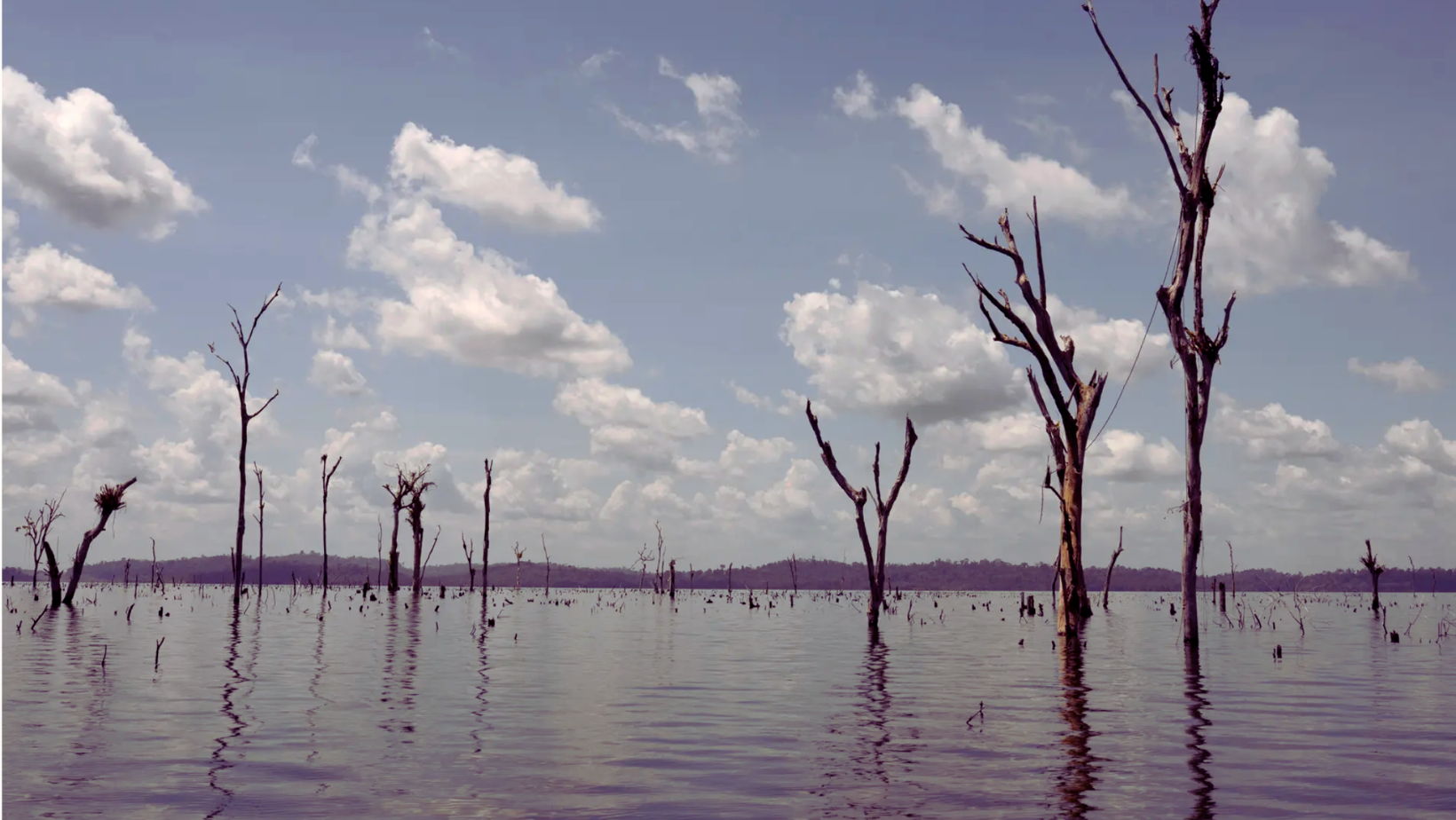
a forest submerged right to the treetops, now dead.
Doña Rosa and her husband were taken from there
and installed in a kind of ghetto in the city
in concrete houses, all identical, all like
sheds, all with a ridiculous little garden
and a plastic playground for the kids.
The dam robbed the water of all motion
and killed the fish, says doña Rosa
who fled from the city and returned to what was left of her land
next to the kapok tree, and the yellow ipês planted by her husband
who died of lung cancer, she says,
although, in reality, he died of a broken heart.
Of pure sadness.
Doña Rosa is also the river.
The great river that flows freely, always eastwards.
And look, from the deck of the ship, you can no longer see the shores
not on one side or the other: the Amazon here is the River-Sea.
Ahead of us lies the island of Marajó, bigger than Switzerland
and we skirt it by turning south, through narrow rivers
until finally
after crossing more than six thousand kilometers
after collecting water from a thousand tributaries
after sixty days inhabiting its waters
the Amazon reaches its mouth
three hundred and twenty kilometers wide
to spill out into the Atlantic.
What started as a stream
a trickle of water in the mountain
is now a torrent traveling at more than thirteen knots
while
it rolls and claps
and curls and frolics
and turns and strikes
and gleams and slaps
and jumps and crashes
and splashes and slams
and discharges two hundred and fifteen million liters
every second
(sixty times more water than discharged by the Nile)
the river smashing into the ocean
(it is the “pororoca”, the “big rumble”)
fresh waters that flow
in the Atlantic to such a distance that
in the year 1500, a certain Pinzón, a Spanish Captain
former companion of Columbus in his voyages
“discovered” the river while sailing several miles
off the Brazilian coast.
He named it Mar Dulce.
You will be thirty-seven years old
when the trip is over
when you finally reach the coast of Belém do Pará
with its Portuguese architecture
and its black neighborhoods, the quilombos
(because the Amazon is also black
and it is not just one, but many Amazons at the same time)
and you will spend the last night at the Feira do Açaí
where men with sweaty backs
are disembarking, packing into sacks
mountains of that purple fruit
while women in floral dresses
dance carimbó to the sound of drums and guitars
around midnight.
The river is three friends having a beer.
The river is asking
more than three hundred people along this journey:
if you could travel through time
fifty, one hundred, one hundred and fifty years
into the future
how do you picture this river
and everything that lives in it?
The river, I know now, is the voice of Vanda Witoto
professor and Indigenous leader from Brazil
hammering into me that:
“For me it is impossible
to think about the future of the Amazon
if we can’t go back to the origin”.
Maybe that’s what it’s all about, after all.
Because everything is born in the water
and dies in it.
Like this river, now drained of words.
English translation: Charlotte Coombe
